


Difficult conversations are part of leadership, but that doesn't make them any easier. Whether it's addressing a behaviour, giving constructive feedback or tackling an uncomfortable issue, even experienced leaders can find themselves putting off a conversation they know needs to happen. The problem is that avoiding it rarely makes things better. In fact, the longer we leave things unsaid, the harder they can become to address.
Imagine a manager whose otherwise capable team member regularly interrupts colleagues in meetings. At first, it seems relatively minor. The manager notices but decides not to make an issue of it. After all, the individual is enthusiastic, knowledgeable and delivers good work. Why risk denting their confidence over something that might not be intentional?
A few weeks pass. Other team members become increasingly reluctant to contribute. Meetings become less collaborative. The manager grows frustrated, while the individual remains completely unaware of the effect their behaviour is having.
By the time the conversation finally happens, it is no longer about a few interruptions. It is about weeks of accumulated frustration, assumptions and unspoken expectations.
The irony is that an earlier, more straightforward conversation might have prevented the snowballing issues.
Difficult conversations are an unavoidable part of leadership. But they don't have to become confrontational, uncomfortable spectacles that leave everyone feeling worse.
With the right intention, a little preparation and a willingness to listen, giving feedback can become an opportunity to build understanding, strengthen relationships and help people grow.
So, how do you get better at having the conversations you'd rather avoid?
1. Understand what makes the conversation difficult
Before thinking about what to say, it is worth understanding why you are finding it difficult to say it.
For many leaders, the hesitation is not about recognising the issue. It is about anticipating the reaction.
Will they become defensive? Will they take it personally? Will it damage the relationship? Will I come across as unreasonable, overly critical or confrontational?
There can also be pressure to find the perfect words. We rehearse the conversation in our heads, consider every possible response and try to construct an approach that guarantees a positive outcome. But that guarantee doesn't exist.
Sometimes we tell ourselves that saying nothing is the kinder option. Yet withholding useful feedback can deny someone the opportunity to understand their impact, address a problem or develop in their role.
There is an important distinction between being kind and avoiding discomfort.
Kindness is not always about making someone feel comfortable in the moment. Sometimes it is about being honest enough to help them move forward.
Before approaching a difficult conversation, take a moment to consider your intention.
What am I trying to create here? Is it greater clarity? A better understanding of someone's behaviour? More accountability? An opportunity for growth? A stronger working relationship?
If your intention is to help resolve an issue rather than to criticise or prove a point, that gives the conversation a very different starting place.
Clarity and care can exist together. In fact, they need to.

2. Address issues before they escalate
The manager in our opening example didn't set out to create a problem. They simply didn't want to make an issue out of something that seemed relatively minor. But in waiting, they allowed the situation to become more complicated than it needed to be.
This is a familiar pattern in organisations. A leader notices that someone is missing deadlines, dominating meetings or communicating poorly with colleagues. They make allowances, hope things will improve or decide to give it a little more time. Meanwhile, the behaviour continues and its impact spreads.
By the time someone intervenes, there may be several people affected and a considerable amount of frustration to work through.
Timely feedback makes a difference. It allows you to address what is actually happening, while the situation is still relatively straightforward. It also gives the other person a fair opportunity to respond and make changes before the issue becomes part of a wider judgement about their performance.
This is one reason feedback should be a regular part of working relationships, rather than something that only happens during formal reviews or when something has gone wrong.
When people are used to exchanging honest feedback, it becomes less of an event. They are more likely to see it as part of how the team works together, rather than an indication that they are in trouble.
That doesn't mean reacting to every minor irritation. It means recognising when something is affecting the work or the people around you and being prepared to address it.
Don't wait for frustration to make the conversation more difficult than the issue itself.
3. Give feedback that people can actually act on
Knowing a conversation needs to happen is one thing. Knowing how to approach it is another.
A common problem with feedback is that it can quickly become personal. Comments about someone's attitude, communication style or lack of commitment might reflect a genuine frustration, but they don't necessarily help the person understand what needs to change.
This is where Anna Carroll's C.O.I.N feedback model can be useful. It provides a straightforward structure for making feedback more specific, constructive and actionable.
C.O.I.N stands for Context, Observation, Impact and Next Steps.
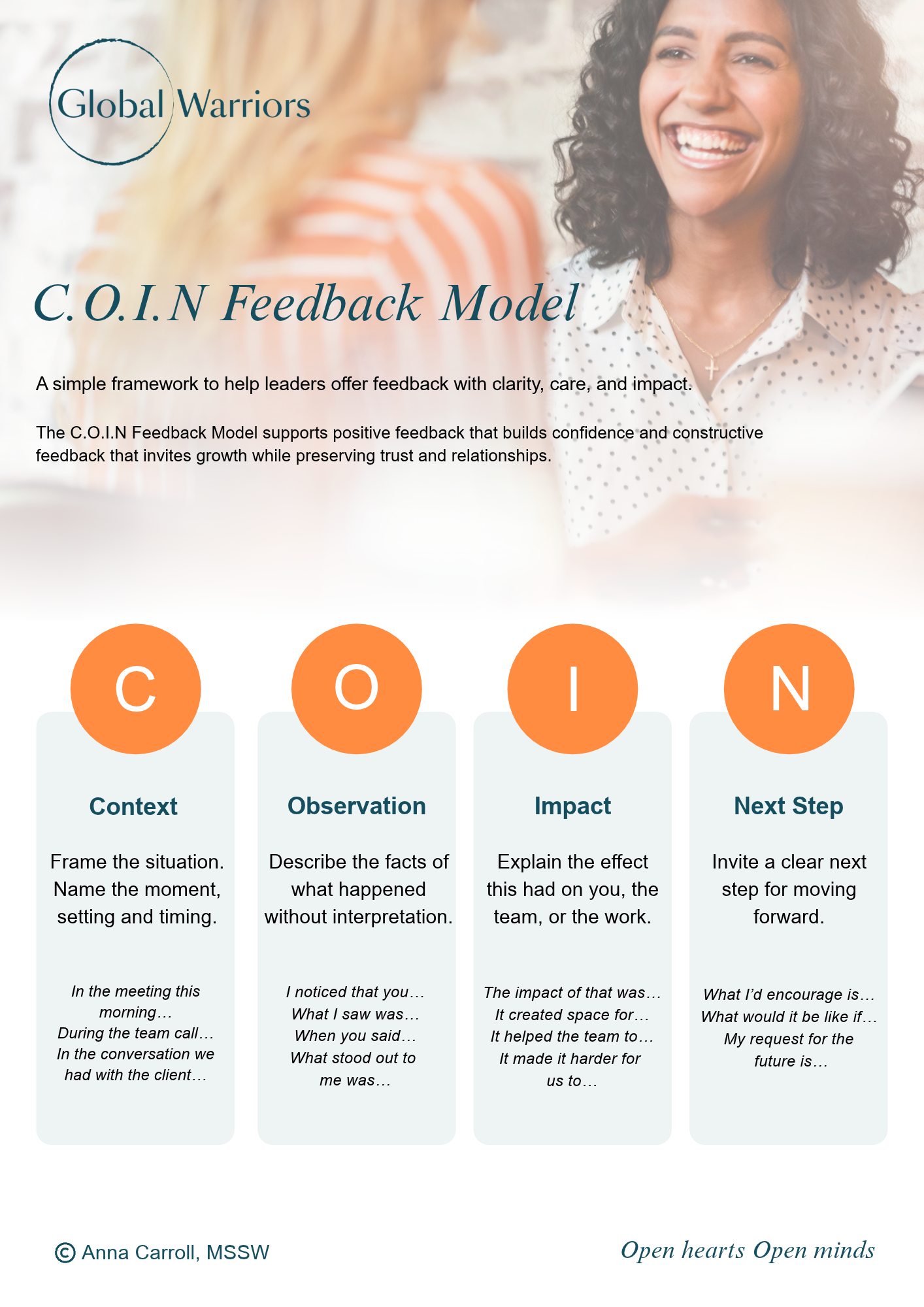
C – Context: Set the scene
Start by explaining the situation you want to discuss. When and where did it happen? What was going on?
For example:
"I wanted to talk about yesterday's project meeting, particularly the discussion around the new campaign."
This gives the other person a clear reference point and helps avoid the feeling that they are being presented with a general criticism.
O – Observation: Describe what actually happened
Focus on what you saw or heard, rather than making assumptions about someone's intentions or personality.
Compare:
"You were dismissive of everyone else's ideas."
With:
"I noticed that when two colleagues suggested alternative approaches yesterday, you interrupted them before they had finished explaining their ideas."
The second example gives the person something specific to respond to. It is much harder to have a constructive discussion about a label than an observable behaviour.
I – Impact: Explain why it matters
Help the person understand the effect their behaviour had on the team, the work or the people around them.
For example:
"The impact was that we didn't get to hear some potentially useful perspectives, and I noticed that a couple of people became less willing to contribute as the meeting went on."
This is an important part of feedback. People don't always recognise how their actions are experienced by others, particularly when their intentions are quite different from the outcome.
N – Next Steps: Agree a way forward
Finally, move towards what could be done differently.
For example:
"In future meetings, I'd like us to make sure everyone has the opportunity to finish sharing their thoughts before we respond. How does that sound to you?"
This gives the conversation direction and makes the feedback practical. Rather than simply highlighting what went wrong, you're establishing what needs to happen next.
The value of C.O.I.N is its simplicity. It helps leaders move away from vague criticism and towards a conversation grounded in specific examples and their impact.
It also provides a useful reminder: feedback should be about behaviour and its consequences, not making judgements about the person.
4. Make room for the other person's perspective
A framework can help you prepare, but it shouldn't turn a conversation into a speech.
Once you've explained what you've observed and why it matters, give the other person an opportunity to respond. They may have a different perspective, additional context or an explanation you hadn't considered.
Perhaps there were pressures affecting their behaviour that you weren't aware of. Perhaps they hadn't realised how they were coming across. Or perhaps they disagree with your interpretation altogether.
Whatever the response, resist the temptation to immediately defend your position or steer the conversation back to what you had prepared.
Ask questions. Listen to the answers. Be prepared to discover something you didn't know.
This doesn't mean backing away from the issue or abandoning the feedback if someone disagrees with you. It means being open to a more complete understanding of the situation.
There is also a balance to strike between listening and maintaining accountability. Someone might have perfectly understandable reasons for missing a deadline, for example, but the impact on the wider team still needs addressing. Understanding what happened can help you find a better solution, without losing sight of what needs to change.
And remember that the conversation doesn't necessarily end when you leave the room. Some issues require follow-up, further support or a check-in to see whether things have improved.
The best feedback conversations are not necessarily the ones where everyone immediately agrees. They are the ones where people leave with a clearer understanding of the issue and a way to move forward.
Difficult conversations are a leadership skill. Practise them.
It is easy to assume that experienced leaders should naturally know how to handle difficult conversations. In reality, the ability to give feedback well is something that develops over time.
Some conversations will go smoothly. Others will be uncomfortable, unexpected or leave you wondering whether you could have handled things differently.
You might struggle to find the right words. You might encounter a reaction you hadn't anticipated. You might realise afterwards that you made an assumption or didn't give the other person enough space to respond.
That is part of learning.
The more familiar you become with having honest conversations, the less likely you are to treat them as something to dread. You begin to recognise that disagreement doesn't have to damage a relationship, that feedback doesn't have to be a personal criticism and that addressing a problem can be an expression of respect rather than confrontation.
For leaders, this also means examining the example they set. If you want people to raise concerns, challenge ideas and give one another constructive feedback, they need to see you doing the same. Open communication has to be practised at every level, not simply encouraged in principle.
Ultimately, good leadership isn't about keeping everyone comfortable or avoiding difficult subjects. It's about creating the conditions for people to do their best work, and sometimes that means having a conversation that neither person would necessarily choose to have.
Ready to help leaders navigate conversations that matter?
At Global Warriors, we help leaders build the confidence, self-awareness and communication skills to navigate challenging situations and have more meaningful conversations. Through our bespoke leadership development and coaching, individuals and teams develop the trust, openness and courage to address what matters and move forward together.
Explore how Global Warriors can support your leadership development →